



Cervical discectomy is the decompression procedure of the cervical spine used in the management of cervical spinal stenosis.
During the operation we remove the disc between two cervical vertebrae and replace it with an implant, in order to decompress the spinal cord and nerve roots and relieve the patient’s symptoms. As an alternative, the bone lying behind the spinal cord can be removed instead.

Discectomy is generally performed through a skin incision at the front of the neck (anterior approach), while decompression by bone removal is generally performed through an incision at the back (posterior approach). The choice between them is complex: it depends on many factors, including the training and expertise of the individual surgeon.
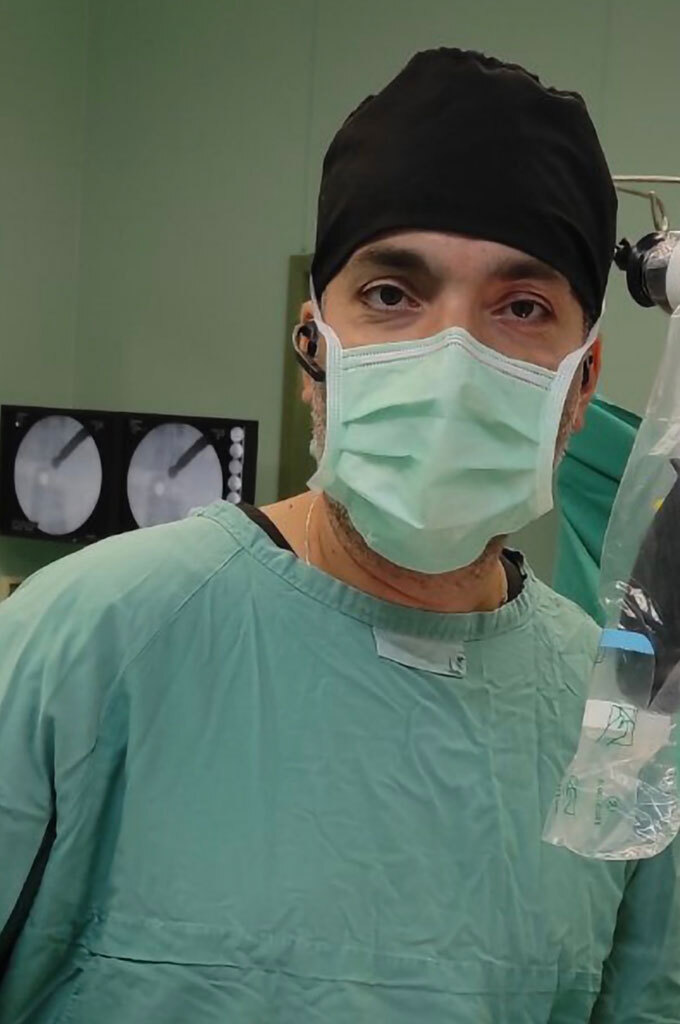
Dr. Alexandros Blionas trained at American Neurosurgical Associates and with specialists from leading centers, including Harvard and Brown Universities, in minimally invasive neurosurgery — with additional training under Marc Sindou, one of the most influential neurosurgeons of his generation.
Anterior approach
The anterior approach is generally more appropriate when fewer levels are affected, when the stenosis is more severe, and when the patient has cervical kyphosis. It always involves an implant, to achieve solid fusion of the vertebrae after surgery.
Anterior cervical surgery is a technically demanding procedure: it is performed in the neck, adjacent to the spinal cord and close to important structures such as the carotid artery, the oesophagus, and the trachea. It therefore carries a small number of serious but rare complications — injury to the carotid artery, the spinal cord, the oesophagus, or the trachea. Although the probability of these is below 0.1%, they can result in paralysis, respiratory failure requiring ventilation, or, rarely, death. The same principle applies to posterior cervical surgery, where the spinal cord is likewise at risk, along with the vertebral arteries immediately adjacent to the surgical field.

For the patient, anterior surgery means a short hospital stay (one to two days) and minimal postoperative pain. Return to normal activities is possible after seven to ten days, avoiding lifting above shoulder height and prolonged or forceful bending of the neck. A common complication is hoarseness, caused by irritation of the recurrent laryngeal nerve, which usually resolves; difficulty swallowing is also frequent and may last several days.
Posterior approach
The posterior approach uses an incision on the back of the neck to reach and remove bony structures lying behind the spinal cord.
It is generally appropriate for disease affecting multiple levels and for a lesser degree of stenosis, and can be used in patients without kyphosis. Instrumentation — chiefly screws and rods — is not always necessary; it becomes so where there is a risk of instability or of kyphosis developing after surgery, which is more common when several levels are treated.
For the patient, the posterior approach generally means a longer hospital stay and considerably more pain: patients usually need significantly more analgesia and take close to a month to return to their activities. The same lifting restrictions apply. The principal complication where no instrumentation is placed and several levels are operated on is instability, presenting chiefly as severe neck pain and often requiring a second operation to place instrumentation. For this reason, instrumentation is frequently placed prophylactically in multilevel surgery.