


What cervical stenosis is
Cervical spinal stenosis affects millions of people. The term refers to a narrowing of the space within the cervical spine through which the nerves and the spinal cord travel. The spinal cord begins high in the neck and ends where the lumbar spine begins, low in the back. It is an exceptionally important structure — the direct continuation of the brain within the spinal column — and injury to it can disturb movement in the arms as well as the legs. That is what makes stenosis in the cervical spine so much more serious than elsewhere.
Symptoms
The characteristic symptoms are sensory and motor, affecting mainly the hands but in some cases the legs as well. Most often patients describe numbness and pain in the hand and fingers, beginning in the neck and travelling down the arm. Less commonly there is weakness in the hands, which typically first shows itself as dropping objects, or being unable to do press-ups.
If the spinal cord itself is significantly compromised by the stenosis, sensation and movement may be affected in the arms and legs at the same time. This condition — a damaged, dysfunctional spinal cord in the neck — is called cervical myelopathy, and its presence changes the management approach fundamentally.
Causes
Stenosis is caused either by hypertrophy of the bone and ligaments, which reduces the space available to the spinal cord and nerves, or by a disc herniation compressing the cord and/or the exiting nerve roots.
Treatment options
For patients with sensory symptoms and pain alone, the options are:
- Watchful waiting
- Strengthening of the neck muscles
- Medication
- Epidural or local injections
- Surgical decompression
In patients without clinical myelopathy, the efficacy of these interventions is in the range of 60–90%.
A note on epidural injections: because the spinal cord runs within the cervical canal, these carry a risk of injuring it, which makes them a less attractive option in the neck than in the lower back. They are generally reserved as an alternative for patients with serious contraindications to surgery.

The efficacy of surgery rises to around 90% when it is used after the other options have been tried and failed. It should be noted that cervical surgery carries a small risk of complications, including a small but real possibility of spinal cord injury. For cervical stenosis with pain or numbness but without myelopathy, we therefore begin with medication; if the patient does not respond adequately, we proceed to surgery.
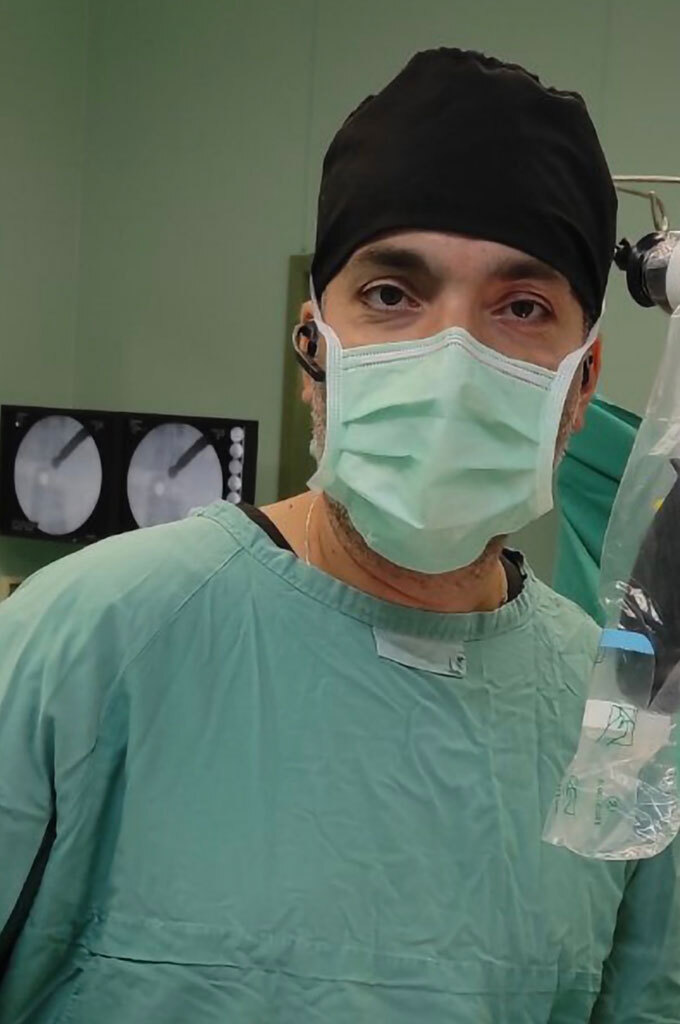
Careful, individualized treatment selection. In accordance with the philosophy of Neurosurgeon Al. Blionas, he proceeds to surgery only when conservative management has failed or is not appropriate. To avoid unnecessary or inappropriate treatment that burdens the patient without result, every case is assessed individually through the AI-supported Personalized Evidence-Based Treatment Analysis, drawing on the patient’s own clinical characteristics alongside the most recent, validated evidence. Each patient is fully informed of what the data show for every option in their particular case, of what to expect, and of how their recovery is likely to proceed.
Surgical treatment of cervical stenosis
The standard operation is anterior cervical discectomy, performed through a small incision at the front of the neck. Removing the disc creates additional space in front of the spinal cord and nerve roots, and relieves the patient’s symptoms.
In certain cases — multilevel disease under specific conditions, for example — the incision is made at the back of the neck instead, creating space behind the cord and nerves and providing comparable relief.