


What a disc herniation is
A lumbar disc herniation occurs when the intervertebral disc — the cushion between two vertebral bodies in the lower back — shifts backwards into the space through which the nerves travel and presses on them. It is specifically the nucleus of the disc that displaces posteriorly and compresses the nerve roots.
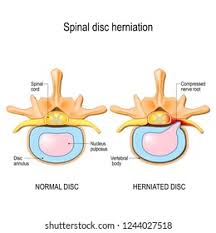
The presence of disc material where it does not belong triggers a reaction from the body in that area: inflammation. Inflammation unfortunately makes matters worse, further reducing the space available to the nerves as they travel out to the muscles they supply.
The result is frequently a disturbance of movement and sensation in the limb — most often pain, and less commonly muscle weakness. The characteristic symptom is sciatica: leg pain originating in the lower back.
Treatment options
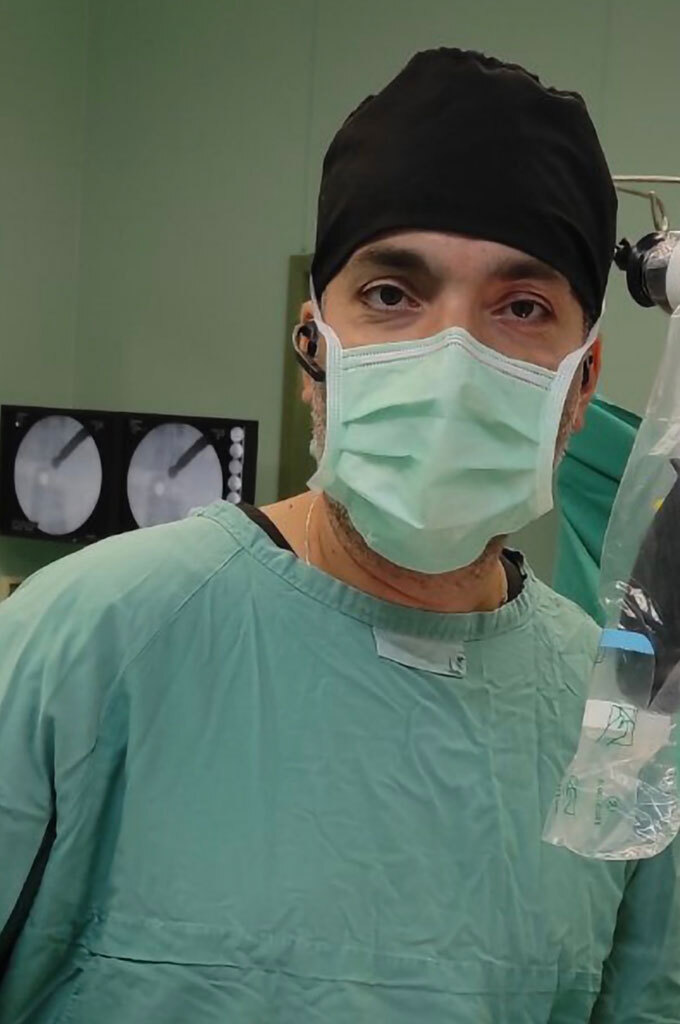
Dr. Alexandros Blionas — trained at American Neurosurgical Associates and by specialists from leading centers in minimally invasive spine neurosurgery, with over 1,000 procedures performed — explains the condition and every treatment option in plain terms, including a new technique of which he is the pioneer in Cyprus and Greece.
The treatment options for a disc herniation are many; only in very specific cases is there just one. Unfortunately, patients are commonly told that a single solution exists, in a blanket and indiscriminate approach. That approach dramatically reduces the effectiveness of treatment.
Below are the options for a patient with straightforward sciatica — pain manageable with medication, without significant leg weakness — alongside the outcome of each, expressed as the proportion of patients achieving more than 50% improvement in symptoms at six months:
| Treatment | Improvement >50% at 6 months |
|---|---|
| Watchful waiting (no intervention) | 50–70% |
| Strengthening of back and abdominal muscles | 70–90% |
| Medication | 60–70% |
| Epidural corticosteroid injection | 70–80% |
| Surgery | 60–90% |
These figures apply to recent-onset symptoms. Where symptoms have persisted for more than a year, watchful waiting has very low efficacy — well below 10% — while the remaining options retain, or increase, theirs.
As is evident, no single option clearly outperforms the rest. In recent-onset cases we therefore work through our therapeutic tools in sequence: conservative measures and core strengthening first, then medication, then epidural injection, and finally — if none of these works — surgery.
That sequence changes when a patient falls outside the average. The classic exception is severe or progressive muscle weakness. When a nerve is injured to the point of causing weakness, the damage is already advanced; such cases need a treatment with rapid onset in order to preserve the strength of the limb, and delay may leave the weakness permanent.
Careful, individualized treatment selection. All of these conservative options are part of Dr. Blionas’ philosophy: he proceeds to surgery only when conservative management has failed or is not appropriate. To avoid unnecessary or inappropriate treatment that burdens the patient without result, every case is assessed individually through the AI-supported Personalized Evidence-Based Treatment Analysis, drawing on the patient’s own clinical characteristics alongside the most recent, validated evidence. Each patient is fully informed of what the data show for every option in their particular case, of what to expect, and of how their recovery is likely to proceed.
Pioneering surgical treatment of lumbar disc herniation
Dr. Blionas treats lumbar disc herniation with minimally invasive techniques: smaller incisions, less muscle trauma, faster recovery, and less postoperative pain.
Microdiscectomy is the best established modern option for the surgical treatment of disc herniation. The results of the technique that Dr. Blionas pioneers in Cyprus and Greece, however, change the picture:
Awake Same-Day Minimally Invasive Lumbar Decompression — decompression of the lumbar spine under sedation, without general anesthesia, with the patient discharged the same day. It offers low complication rates, considerably less pain, high success rates, and a shorter recovery. The technique is performed at only a few leading medical centers worldwide — including NHS Trust hospitals in Cambridge and Oxford (UK) and the Mayo Clinic (USA) — and, in Cyprus and Greece, by Dr. Blionas.
See in detail: Awake Same-Day Minimally Invasive Lumbar Decompression