



What a brain tumor is
A brain tumor is a mass of cells occupying space where they should not be. Because they inevitably take up volume within a closed skull, they are described as a space-occupying lesion.

Tumors may arise from the brain itself (primary tumors) or from other organs and spread to the brain (metastases).
The term covers both benign tumors — chiefly meningiomas — and malignant ones, chiefly gliomas, although there are many other types, each with its own behavior, management, and prognosis.
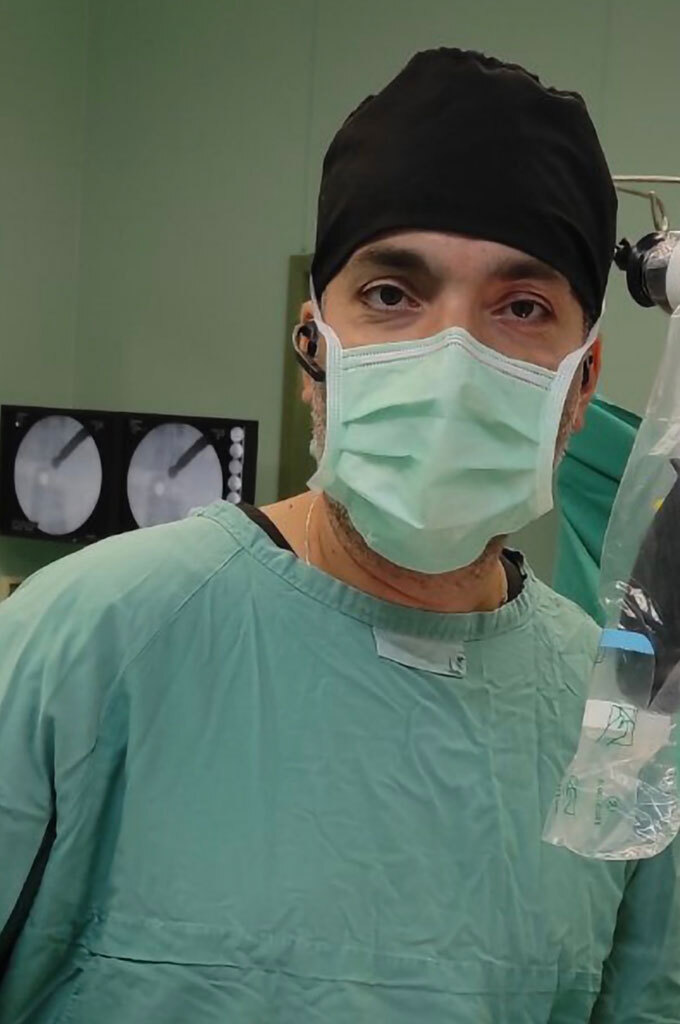
Dr. Alexandros Blionas, whose three-year specialist training focused primarily on cranial neurosurgery — aneurysms, endoscopic procedures, and skull base tumors — at one of Greece’s most advanced neurosurgical departments, explains the diagnosis and management of brain tumors in plain terms.
Diagnosis
Brain tumors are generally diagnosed on MRI, usually with contrast to optimize imaging.
MR spectroscopy is a further refinement. Rather than showing the shape of a lesion, it measures the chemicals within it — a pattern that helps narrow the diagnosis when the images alone are not conclusive.
Where imaging cannot provide sufficient certainty, tissue sampling is required: either surgical removal with the specimen sent for histology, or a biopsy alone. Biopsy alone is appropriate when the tumor is considered inoperable because of its extent or its presumed malignancy, and also when the findings suggest a benign lesion that does not require removal but whose exact nature remains uncertain.
Prognosis
Prognosis depends on the size, type, and location of the tumor, and on the treatment given.
A benign tumor does not automatically mean a good prognosis: five-year survival after diagnosis ranges from around 30% to close to 100%, depending on the location, the tumor type, and the quality of management. Equally, a malignant tumor may carry a five-year survival as low as a few percent — for a metastasis from an aggressive primary — around 10% for a high-grade primary brain tumor, but up to approximately 97% for tumors of lower grade.
It should be emphasized that prognostic figures are statistical averages. A small proportion of patients with highly malignant tumors and very poor average survival live far longer than expected — decades, in some cases, without further problems. Conversely, a small proportion of patients with benign, favorable tumors may not survive a year, for a variety of reasons. What matters is that management and treatment are done properly, whatever the average prognosis suggests.
Treatment options
The available options are surgery, radiotherapy, radiosurgery, chemotherapy, and watchful waiting.
- Watchful waiting with regular imaging is an option for small, asymptomatic benign or very low-grade tumors in a safe location, with intervention only if a significant change occurs.
- Complete surgical removal is the ideal management for benign tumors that are large, situated in a dangerous location, or causing significant symptoms.
- Surgical resection followed by radiotherapy and/or radiosurgery is the ideal treatment for high-grade malignant tumors, depending on the tumor type and location.
- Radiotherapy and/or chemotherapy alone, with or without a biopsy depending on diagnostic certainty, may be used where surgery is not appropriate because of extensive spread or a difficult location. The quality and extent of surgical resection is critically important and has a major influence on survival.
Careful, individualized treatment selection. For patients with a brain tumor, every treatment option is assessed individually through the AI-supported Personalized Evidence-Based Treatment Analysis, drawing on the patient’s own clinical characteristics alongside the most recent, validated evidence. Each patient is fully informed of what the data show for every option in their particular case, and of what to expect. Online consultations and second opinions are also available.