


What low back pain is
Low back pain will affect at least 50–80% of the population at some point. It causes considerable disruption, leaving patients unable to work or to meet their daily responsibilities.
Low back pain is pain confined to the lower back, without radiating to the legs or elsewhere. It may worsen with changes of posture, with lifting, or on bending. It can arise from the muscles of the lower back, but it is commonly caused by problems in the spine itself.
Dr. Alexandros Blionas — trained at American Neurosurgical Associates and by specialists from leading centers in minimally invasive spine neurosurgery, with over 1,000 procedures performed — explains the condition and every treatment option in plain terms:
The pain is confined to the lower back, but its source may be either the muscles or the spine itself. Matters are considerably more difficult when the problem lies within the spine, and it is often hard to determine which of the two is responsible, since both are frequently affected at the same time.
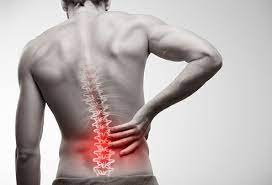
The source of low back pain may be the muscles or the spine itself.
A defining feature of low back pain is that it is generally harder to treat than sciatica. Whereas in sciatica spontaneous resolution reaches up to 70% and successful outcomes from treatment up to 95%, in low back pain spontaneous resolution is usually just above 50% and successful outcomes from treatment do not exceed 70%.
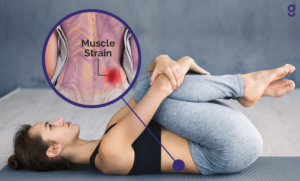
An injured point in the lower back muscles, where a localized spasm may develop in reaction to injury or increased load.
What causes low back pain
Muscle spasm or injury of the lower back muscles is the commonest cause, usually following a sudden movement or increased load from work or lifting. There is typically a localized point of tenderness, and the pain changes with posture. Muscles are frequently overloaded because the spine is inadequately supported, so the load is transferred to the muscular system.
Facet joint degeneration (facet arthropathy) is another significant cause. Wear at the joints between the vertebrae leads to erosion and inflammation, producing pain when the spine is loaded. This is called axial pain: it appears on lifting, climbing stairs, bending, and generally when the spine is loaded or subjected to vibration such as running or jumping. The facet joints are particularly vulnerable in two situations — when the back and abdominal muscles are weak, so that more load is transferred to the joints, and when the intervertebral discs have degenerated, since the discs normally absorb a large proportion of shock and load.
Disc degeneration may itself cause pain as the vertebrae come closer together, and in some cases into direct contact. There is also the theory of discogenic pain — pain arising from within the affected disc — which remains a contested area and is not fully established.
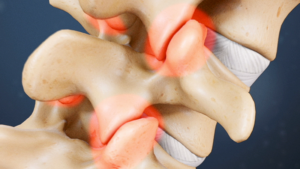
Inflammation of the facet joints (shown in red), typically from age-related wear and increased loading, causing axial low back pain.
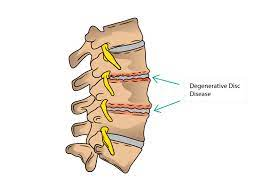
The discs act as cushions absorbing shock and load, like the shock absorbers of a car; a degenerated disc no longer functions properly and the vertebrae come closer together.
Spinal instability is the final important cause. When the connections between the vertebrae fail to function properly, there is excessive movement between them during activity, or even at rest; a common form is spondylolisthesis, where a vertebra slips out of its normal position. The result is either contact between vertebrae, excessive loading of the facet joints, or compression of neural structures during movement — producing axial low back pain that worsens with lifting, bending and movement, or, less commonly, neurological symptoms such as weakness or numbness.
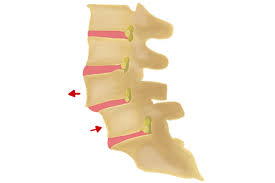
Instability: the vertebrae move out of their normal position with movement, or may be permanently displaced. Where displacement or excessive mobility is significant, or symptoms are marked, fusion becomes necessary.
The causes of instability include fractures and degeneration of the joints and connections between the vertebrae. It is identified with flexion-extension radiographs — X-rays taken in motion, which reveal excessive vertebral movement. CT is also needed, to demonstrate fractures and to show displacement more clearly.
Management always depends on the cause. Where there is significant instability or substantial vertebral displacement — in the context of a fracture or another disorder — surgery with lumbar spinal fusion is generally required, particularly when neurological signs such as weakness are also present.
Treatment options
Medication. Where there is no instability and the patient simply has low back pain, conservative management should be started, beginning with drug treatment aimed at reducing the inflammation in the joints and between the vertebrae. Success rates are unfortunately much lower than in sciatica: only 50–60% of patients achieve more than 50% symptom reduction at six months.
Treatment includes anti-inflammatory drugs and muscle relaxants. The relaxants target the spasm and muscle injury caused either by sudden movement and loading, or secondary to instability, facet degeneration, or disc degeneration — all of which transfer more load onto the muscles.
The difficulty with muscle relaxants is that we cannot always tell whether the spasm results from an internal cause that both overloads the muscles and independently causes pain, or from an isolated muscle injury following overload. In many patients the two coexist, with no reliable way of establishing which predominates. In practical terms, muscle relaxants may prove insufficient if the pain stems from a persistent internal cause such as facet arthropathy or instability.
Botulinum toxin injection. In carefully selected cases, where there is a focal area of spasm and tenderness, a local injection of botulinum toxin (Botox) into the paravertebral muscles can relieve the spasm and, by blocking transmission at the neuromuscular junction, reduce the pain arising from that site. Reported efficacy in patients with a well-localized point of tenderness and focal pain reaches up to 60%, with a duration of action of three to four months. It should be noted that the evidence base for botulinum toxin in low back pain remains limited and it is not part of standard first-line management.
Very often, however, an underlying spinal cause is also present — facet arthropathy, degenerative disc disease, or instability. Where that underlying condition is the main or the only source of the pain, botulinum toxin may be only partly effective, or ineffective altogether.
Epidural injections. These have some efficacy in pure low back pain. They are ideal for patients who also have sciatica of comparable intensity; where low back pain is the dominant problem, the results are clearly inferior. In patients with isolated facet arthropathy and no other lesion, efficacy against the low back pain itself is below 50%. Where the cause is disc pathology and/or instability, it may approach 60%.
Facet joint (intra-articular) injections. A different form of injection delivers medication directly into the affected joints between the vertebrae. The injection is performed under fluoroscopic guidance so that the joint can be targeted precisely, and consists of a mixture of local anesthetic and corticosteroid, which anesthetizes the area and treats the inflammation within the joint, relieving axial low back pain. Several joints are usually injected in the same session. In patients with isolated facet arthropathy, relief reaches up to 70%; where other problems coexist — degenerative disc disease and/or instability — efficacy is more limited, since the deeper source of pain remains untreated.
Careful, individualized treatment selection. All of these conservative options are part of Dr. Blionas’ philosophy: he proceeds to surgery only when conservative management has failed or is not appropriate. To avoid unnecessary or inappropriate treatment that burdens the patient without result, every case is assessed individually through the AI-supported Personalized Evidence-Based Treatment Analysis, drawing on the patient’s own clinical characteristics alongside the most recent, validated evidence. Each patient is fully informed of what the data show for every option in their particular case, of what to expect, and of how their recovery is likely to proceed.
Surgical treatment of low back pain
Where conservative treatment has failed over the long term — generally beyond six to twelve months — surgery becomes an option.
When the vertebrae move out of their normal position on movement, or are permanently displaced, and when that displacement or excessive mobility is significant or symptoms are marked, lumbar spinal fusion is required, with the aim of stabilizing the spine completely.
In patients who have already been operated on for a disc herniation that has recurred, or where there is concurrent degenerative disc disease, an interbody device may also be used. This effectively replaces the disc, maintaining the correct height between the vertebrae and absorbing part of the mechanical load carried by the spine. The rationale of the operation is to unload the facet joints completely, restore normal disc height and alignment between the vertebrae, and correct the instability and excessive movement.
Together, these relieve the patient of the low back pain and of any accompanying neurological symptoms.