


Dr. Blionas performs minimally invasive spine surgery having trained at American Neurosurgical Associates and with specialists at leading centers (Harvard and Brown Universities).
Advantages
Minimally invasive spine surgery (MISS) is performed through very small incisions and offers the patient a shorter hospital stay, less postoperative pain, less blood loss, and a faster return to daily activities.
In appropriately selected patients, it is as effective as conventional open surgery — with fewer complications. This is the essential point: minimally invasive techniques have not been shown, across the published studies, to be more effective than open surgery. Their advantage lies in achieving the same result with less surgical trauma, provided the patient is correctly selected. Applied indiscriminately, to cases where the problem cannot be fully addressed through the narrow corridor, they lead to higher reoperation rates.
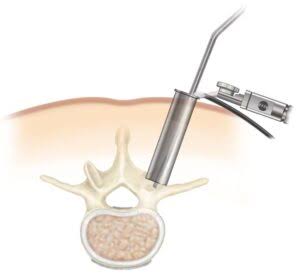
The rationale of minimally invasive spine surgery is the use of specialized tubes to create surgical corridors that lead with absolute precision to the surgical target, causing the least possible damage to the patient’s body.
How it is performed
The essence of any spinal decompression is the removal of the structures compressing the nerves — bone, herniated disc, or hypertrophied ligament — so that the nerves regain space and the symptoms subside. In minimally invasive surgery this is achieved through very small incisions, with the aid of advanced technology.
Through an incision of a few millimeters, a micro-tube is placed, creating a precise anatomical corridor to the site of the problem. A 3D 4K video-robotic microscope (exoscope) provides enormous magnification and detail through that corridor, and the surgeon uses specialized micro-instruments to remove the tissue compressing the nerve — without cutting or detaching the surrounding muscles, as conventional surgery requires.
The reduced muscle trauma is precisely what underlies the faster recovery, the reduced blood loss, and the lower postoperative pain.
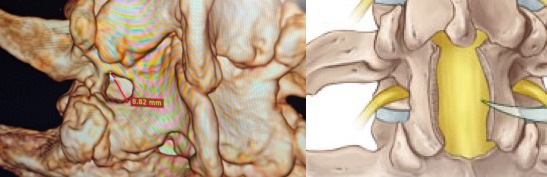
In the image you can compare one of the physician’s procedures against a classic open surgery. The amount of bone removed in classic surgery is considerably greater, therefore the damage is also greater and complications are more frequent.
Careful patient selection
Minimally invasive techniques are safe and effective, but they are not suitable for every patient, and we do not take a one-size-fits-all approach to treatment selection. Every candidate is assessed individually through the AI-supported Personalized Evidence-Based Treatment Analysis, based on their own clinical characteristics and the most recent, validated scientific evidence. Each patient is fully informed of what to expect and how their recovery is likely to proceed.
The techniques
Minimally invasive approaches can be applied to most spinal decompression procedures, including:
- Lumbar microdiscectomy — removal of a herniated disc through a micro-tube
- Laminectomy / hemilaminectomy — decompression of the spinal canal
- Foraminotomy — widening of the opening through which the nerve exits
- Cervical discectomy
- Lumbar spinal fusion — using percutaneous screws
Awake Same-Day Minimally Invasive Lumbar Decompression — the pioneering technique performed without general anesthesia, under sedation, with same-day discharge
See in detail: Awake Same-Day Minimally Invasive Lumbar Decompression