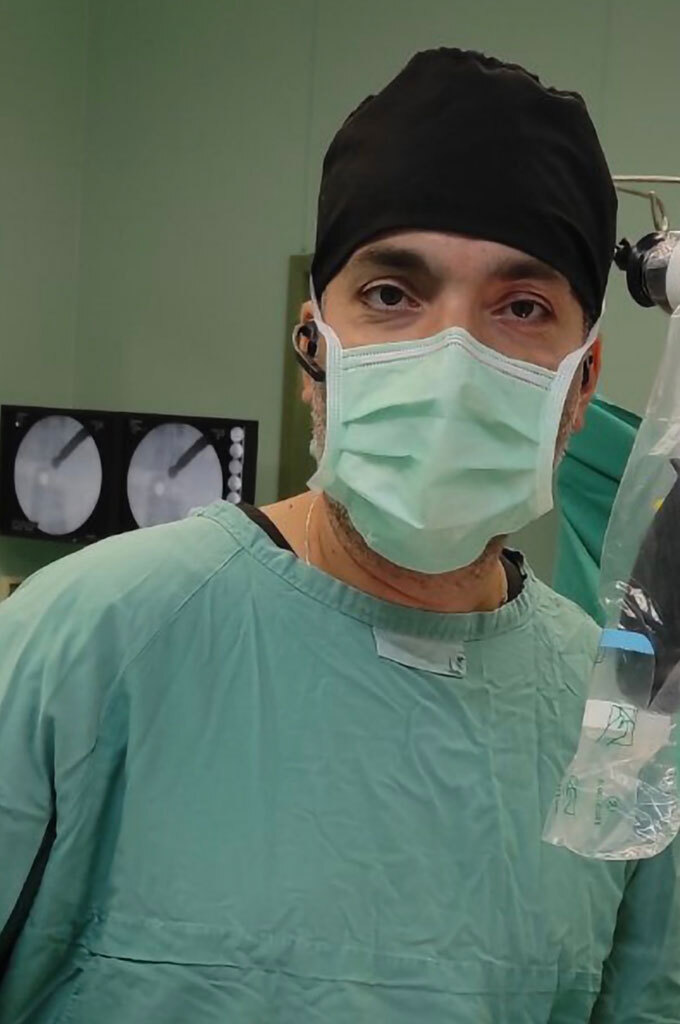



Dr. Alexandros Blionas applies advanced techniques in spinal injections as well. Instead of the classic “blind” injection into the epidural space, the injection is performed under image guidance, targeting precisely the affected level and nerve root.
If, for example, the L4 root is compressed at its exit through the foramen or at its origin from the dural sac, a transforaminal injection is delivered exactly at the point of compression. The technique is considerably more demanding, but it places the drug where it is needed rather than distributing it generally through the epidural space.
A further technique used is hydrodissection, in which a larger volume of fluid is administered at the affected site. The fluid separates the nerve from the structures compressing it — bone, ligament, or disc — increasing the space available and reducing symptoms.
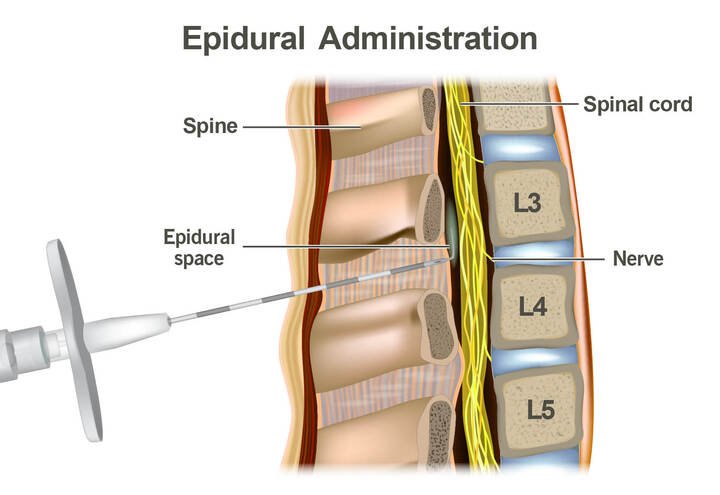
What you need to know about epidural injections
An epidural injection is the delivery of medication into the epidural space, preferably under image guidance. It is performed chiefly for lumbar spinal stenosis, and for lumbar disc herniation causing sciatica or other neurological symptoms.
The epidural space is the space within the spinal canal immediately surrounding the nerves, running the length of the spine. Its advantage is that the drug acts locally, at the site of the problem: only small amounts reach the systemic circulation, so the side effects associated with oral medication are largely avoided, and the drug continues to act locally for a prolonged period.
The mixture administered contains a local anesthetic and a corticosteroid — the first for immediate pain relief, the second for its anti-inflammatory effect. Epidural injections are therefore an option wherever stenosis or a herniation is producing inflammation and pain, which is the case in the majority of patients. The medication primarily relieves the pain and secondarily increases the space available to the nerves, reducing the symptoms.
Efficacy and what to expect
Efficacy ranges between 60% and 70% — that is, 60–70% of patients achieve more than 50% improvement in their symptoms at six months. The injection may need two to three weeks to reach its full effect.
More than one injection a year is often required to maintain the result. When the effect begins to wear off, we discuss a second or a third injection; beyond three per year, the evidence does not show additional benefit. Of the patients who achieve a satisfactory result, roughly half need a single injection per year and the rest two or three. Around 30% of patients who try the technique do not obtain adequate benefit, or find the effect too short-lived.
On current evidence, epidural injections are among the most effective interventions available for sciatica, with an average pain reduction in the order of 5–6 points on the visual analogue scale.
In practice they are a very good option either as a first-line treatment or after medication has failed. They are one of the few interventions with proven efficacy and a very low complication rate, and therefore an excellent choice for patients who wish to avoid surgery, provided there is no surgical indication.
Their main limitation is, of course, that they do not eliminate stenosis or herniation: they treat the symptoms for a period of months. Where the symptoms have been present for a short time before the injections begin, the patient may no longer need them after one to two years, because the underlying problem has resolved on its own. Where symptoms have been long-standing, that possibility is small, and the therapeutic choice must be weighed carefully.
As with medication, the long-term result relies on the body’s own mechanisms, which resolve the problem in a proportion of patients (50–70%). In the remainder (30–50%), the problem does not correct itself and a defined number of injections is repeated annually.
Facet joint injections and radiofrequency neurolysis
Where the pain arises predominantly from the facet joints, intra-articular facet injections serve two purposes: they relieve the pain for approximately three months, and they identify with a high degree of confidence which patients will benefit from radiofrequency neurolysis (RF ablation) — a technique that provides longer-lasting relief from low back pain without the burden of an operation.
PRP as an injection solution
Dr. Blionas also uses Platelet-Rich Plasma (PRP) as an injection solution. PRP is autologous — prepared from the patient’s own blood — and therefore carries an excellent safety profile. In appropriately selected patients it can extend the duration of benefit compared with a corticosteroid preparation. It should be noted that the evidence base for PRP in spinal injections, while growing, remains less established than that for corticosteroid injections.
Therapeutic results with conservative treatments for sciatica & low back pain are also achieved through Ozone Therapy.
See also: Radiofrequency neurolysis for low back pain
See also: Ozone therapy for sciatica and low back pain
See also: Awake Same-Day Minimally Invasive Lumbar Decompression