


For patients with low back pain there is a treatment that avoids the burden of surgery and the placement of implants in the spine.
How it works
The rationale of lumbar neurolysis is simple. The facet joints of the lumbar spine are supplied by small sensory nerves — the medial branches of the dorsal rami. When these joints are degenerate and the nerves supplying them are irritated, the result is pain, typically severe axial low back pain. Radiofrequency neurolysis interrupts the transmission of that pain by ablating those nerves.
Under fluoroscopic guidance, electrodes are positioned precisely on the medial branch supplying each affected joint. Radiofrequency energy is then applied, which interrupts the nerve for an extended period and relieves the patient of the pain.

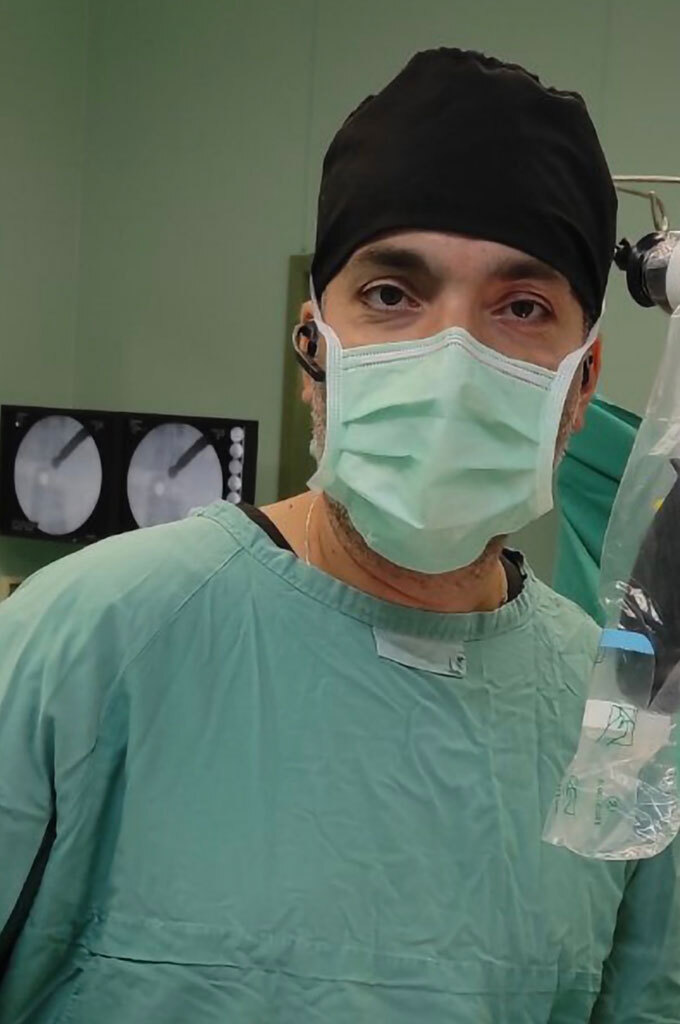
The image shows the electrode positioned on the nerve supplying the affected joint, under image guidance.
The nerve remains inactive for approximately one to two years, after which it regenerates — so the procedure can be repeated if symptoms return. Importantly, only the small sensory branch to the joint is targeted: strength and sensation in the leg are unaffected.
Confirming that the joint is the source of the pain
Before proceeding to ablation, the diagnosis can be tested. A small amount of local anesthetic is delivered, again under image guidance, to each medial branch — a diagnostic medial branch block — deactivating it temporarily. If the patient’s pain resolves satisfactorily after this temporary block, it confirms with a high degree of confidence that the facet joints are the source of the pain and that neurolysis will provide lasting relief.
Intra-articular facet joint injections serve a similar purpose: they relieve the pain for approximately three months and identify, with high confidence, which patients will benefit from neurolysis.
Results
In appropriately selected patients — those with a positive diagnostic block — reported efficacy reaches up to 80%, with a complication rate below 1% and a duration of benefit of up to two years or more.
It is a valuable option for axial low back pain of facet origin, allowing the patient to avoid the complications of a spinal fusion, whose outcome in this setting is often uncertain. It should be emphasized that patient selection is what determines the result: applied without a confirmatory diagnostic block, efficacy falls substantially.