


Sciatica is an extremely common symptom, affecting the lives of millions of people every year: up to 40% of us will experience it at some point.

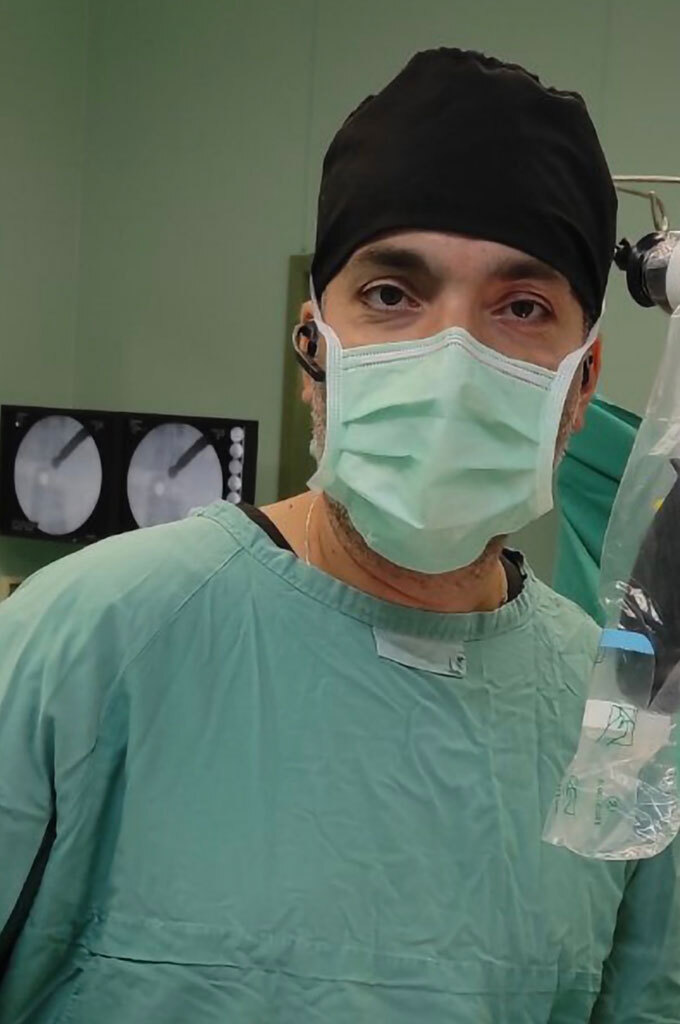
Dr. Alexandros Blionas specializes in personalized minimally invasive surgery, with over 1,000 procedures performed. He is a pioneer of Awake Same-Day Minimally Invasive Lumbar Decompression for sciatica — performed under sedation rather than general anesthesia, with same-day discharge. The overview below covers sciatica and the full range of treatment options, conservative and surgical, as supported by current evidence.
Causes and symptoms
Sciatica is traditionally defined as pain following the distribution of the sciatic nerve — beginning in the lower back or buttock and radiating down the leg. The sciatic nerve is one of the largest in the body; it is formed by the lumbar and sacral nerve roots as they emerge from the spine and join together. A patient with typical sciatic pain is therefore very likely to have some form of injury or irritation of the sciatic nerve or its roots.
The most common cause is compression of the lumbar nerve roots. This usually happens in one of two ways. A disc herniation occurs when the soft inner material of a disc pushes out and presses directly on a nerve root — typically sudden in onset. Spinal stenosis is a gradual narrowing of the spinal canal, or of the openings through which the nerve roots exit, most often from age-related thickening of the ligaments and enlargement of the facet joints. Less commonly, compression follows a fracture or a slipped vertebra, and rarely it is caused by a tumor or an infection — both of which are shown clearly with MRI. Not all sciatica originates in the spine, and a full assessment is needed before treatment is decided.
Treatment options
Sciatica often improves without any intervention. Where the cause is a disc herniation, the body is able to break down and reabsorb the displaced disc material: inflammatory cells recruited to the area gradually clear it, and as the pressure on the nerve root falls, the symptoms settle. Between 50% and 70% of patients improve by more than half within six months of onset, with no treatment directed at the disc itself.
Spinal stenosis behaves differently. The thickened ligaments and enlarged joints that narrow the canal do not resolve on their own. Here the aim of non-surgical treatment is to control symptoms and maintain function, rather than to wait for the narrowing to reverse.
When waiting is not the right approach
Two situations change the picture entirely.
The first is significant muscle weakness — a foot that drags, difficulty rising onto the toes or heels. Weakness means the nerve is not merely irritated but injured, and the longer the compression continues, the greater the risk that the loss becomes permanent. Where weakness is significant, the fastest route to decompression is the right one, and that is usually surgery.
The second is loss of bladder or bowel control, or numbness in the groin, buttocks, or inner thighs. These may indicate cauda equina syndrome, and they require same-day assessment in an emergency department — not an outpatient appointment.
Conservative management
Conservative treatment follows from the principle above: relieve the patient’s symptoms so that the body has time to resolve the problem on its own, to the point where no further intervention is needed. This does not always happen, but it happens often enough that it is the reasonable place to start in the absence of the warning signs described above.
Medication. Drug treatment has two aims. The first is to reduce inflammation around the nerve root, which is what drives much of the pain in the early weeks; anti-inflammatory treatment can interrupt the cycle in which inflammation and pain reinforce one another. The second is simply to keep the patient comfortable while the natural course of the condition plays out. Medication does not address the underlying problem — it removes neither the herniated disc nor the tissue causing the stenosis — and symptoms often return once treatment stops, whether immediately or after months. Side effects such as dizziness, drowsiness, and stomach irritation limit how long treatment can reasonably continue, and for some patients rule it out.
Physiotherapy. Medication is usually combined with physiotherapy, aimed at strengthening the muscles that support the spine. A stronger support system reduces the mechanical demand on the affected segment and can substantially reduce symptoms even though the herniation or stenosis is still present. Physiotherapy also restores confidence in movement, which matters more than it might appear: patients who stay active recover faster than those who rest. The practical difficulty is timing — in the acute phase the pain itself makes meaningful physiotherapy hard, which is why it is generally started alongside pain control rather than instead of it.
Where symptoms have not improved after several months, or where they are too severe for the patient to continue on this course, the next options are considered together with the neurosurgeon.
Epidural spinal injection
This is a minimally invasive option. A mixture of two drugs — a local anesthetic and a corticosteroid — is delivered under imaging guidance directly around the affected nerve root. The anesthetic relieves the pain immediately; the corticosteroid acts on the inflammation locally over the following days.
Its main advantage is the near-absence of systemic side effects: the drug acts where it is placed and enters the bloodstream only in small amounts. It spares the patient continuous oral medication, and it can be repeated when necessary. Like medication, it does not remove the herniation or the stenosis — it treats the inflammatory component of the problem, which in many patients is enough to allow recovery to proceed.
Relief typically begins within days. Its duration varies considerably between patients: some obtain lasting benefit, others find that symptoms return after some months. Where a single injection gives partial relief, a second or third may be performed; standard protocols allow up to three per year.
A pioneering variation: PRP instead of corticosteroid
Dr. Blionas is among the first in Greece and Cyprus to use Platelet-Rich Plasma (PRP) as the injected solution. PRP is autologous — prepared from a small sample of the patient’s own blood — which gives it an excellent safety profile.
The difference is one of mechanism. A corticosteroid suppresses inflammation; PRP delivers a concentrated preparation of the patient’s own growth factors to the affected area. Comparative studies report that the benefit can last up to twice as long as with a corticosteroid preparation, with fewer side effects — since PRP avoids the effects associated with repeated steroid exposure altogether.
That makes it particularly valuable for patients in whom corticosteroids are best avoided: those with diabetes or osteoporosis, and those who have already had several steroid injections and cannot safely have more.
It should be noted that the evidence base for PRP in spinal injections, while growing rapidly, is less established than that for corticosteroids — which is precisely why the choice between them is made individually, on the evidence available for each particular case.
Surgical treatment
Surgery removes whatever is compressing the nerve: part of the canal wall — the lamina or a portion of it (laminectomy, hemilaminectomy, fenestration) — or the herniated disc material pressing on the nerve root inside the canal or as it exits. The aim is to free the nerve, so that the leg pain and the neurological symptoms resolve.
In principle the relief is immediate, since the cause is removed. In practice, reported success rates range from 60% to 90% — defined as a reduction in symptoms of more than half at six months. That definition matters: a proportion of the patients counted as successes improve by 50–60%, which for some is not enough.
The difference between the lower and upper ends of that range is patient selection. Operating indiscriminately produces results near the bottom of it; careful selection produces results near the top. The single most important element is stepwise management — reserving surgery for patients whose symptoms have not settled with non-surgical treatment, and whose imaging findings correspond to their clinical picture. Dr. Blionas applies a structured, individualized selection process, drawing on each patient’s own characteristics alongside current validated evidence.
Surgery also carries risks, which are discussed in full before any decision is made. These include infection, dural tear, and recurrence of the herniation, and they are part of the reason the operation is offered when the alternatives have been exhausted rather than at the outset.
An option for patients who cannot, or prefer not to, undergo conventional surgery
There is a substantial group of patients — those with multiple medical problems, obesity, advanced age, or other serious contraindications — who live with chronic sciatica, have not been helped by other treatments, or decline surgery specifically because of the general anesthetic.
For these patients, Dr. Blionas offers Awake Same-Day Minimally Invasive Lumbar Decompression: decompression performed under sedation, without general anesthesia, with same-day discharge. By avoiding general anesthesia and minimizing tissue disruption, the technique is associated with reduced blood loss, fewer anesthesia-related complications, less postoperative pain, and faster recovery in appropriately selected patients.
See in detail: Awake Same-Day Minimally Invasive Lumbar Decompression
Click here to watch a Video presentation by Dr. Blionas on how to avoid surgery when you got sciatica.