


A very interesting question that concerns many patients is which treatment option is the most effective for sciatica, when it is caused by lumbar spinal stenosis / disc herniation.
What do we mean by sciatica? It is the pain that follows the distribution of the sciatic nerve due to pressure on some part of it. In our specific case, we are referring to pressure on the nerve roots due to reduced space, i.e. stenosis, or due to a disc herniation that compresses them.
How do we define effectiveness in sciatica? The effectiveness we measure in studies generally refers to the reduction in pain experienced by patients, which is defined based on the visual analogue scale for pain.
The visual analogue pain scale ranges from 0 to 10. Zero is defined as no pain at all, while 10 is considered the worst pain a patient can imagine. We ask the patient before treatment how they rate their pain on the analogue scale, and we ask again after treatment. The change in pain level on the scale compared to before surgery or intervention constitutes the calculated effectiveness of the treatment. For example, if a patient had pain of 8 out of 10 before surgery and after surgery has pain of 2 out of 10, we consider the effectiveness of the surgery to be the difference, i.e. 6 out of 10.
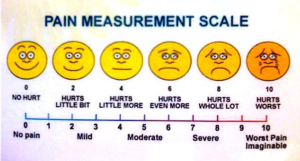
An important tool is the visual analogue pain scale where we ask the patient to “rate” their pain from 0 to 10. Based on the difference in pain before and after the intervention, we can evaluate our treatments.
Several systematic studies and meta-analyses have attempted to answer this question by collecting all studies conducted on the various treatments for sciatica, evaluating and comparing their effectiveness.
We have gathered all these high-level studies and present them here. For convenience, we will divide the treatment options into three categories – tiers, according to the level of calculated effectiveness.
1st Tier – Low Effectiveness
The first tier of treatments has demonstrably low effectiveness, reducing the visual analogue pain scale by zero to 1.5 points.
In this category fall cortisone, Non-Steroidal Anti-Inflammatory Drugs, the drug Lyrica, and physiotherapy. Although these therapeutic interventions may have low effectiveness individually, it is possible to combine them, cumulatively creating a satisfactory level of effectiveness.
For example, a patient may take anti-inflammatory drugs, cortisone, and undergo physiotherapy simultaneously. By combining all of these, the patient benefits from the sum of all interventions, and sometimes gains even more due to dynamic synergy between treatments. The traditional cocktail of medications including cortisone, anti-inflammatories, and physiotherapy together with Lyrica can cumulatively reach an overall effectiveness of 3 out of 10.
Of course, when a patient is forced to discontinue cortisone and anti-inflammatories, which cannot be taken for extended periods, effectiveness will drop to only 1.5 out of 10, i.e. that of physiotherapy and Lyrica alone. First-tier therapeutic interventions will gradually be abandoned in clinical practice as standalone solutions and will serve more as adjuncts alongside other treatment options. At present, they are quite widespread, however their reduced effectiveness creates many problems for both patients and physicians.
There are specific categories of patients, however, for whom first-tier medications have increased effectiveness, and therefore in correctly selected patients they can achieve considerably greater results, which may be satisfactory for the patient. Proper patient selection is therefore of utmost importance.
2nd Tier – Moderate Effectiveness
Second-tier treatments have an effectiveness of around 3 out of 10 each individually. These treatments include antidepressant medications as well as the drug Neurontin, also known as Gabapentin. These treatments can also be combined with each other, creating a cumulative effectiveness that is quite impressive.
Unfortunately, however, these are treatments that cause significant drowsiness and other side effects in patients, and therefore their combination is very often not feasible, especially in older age groups. Furthermore, in many cases the above pharmacological options are not individually tolerated by patients, and it is therefore a common occurrence that a significant proportion of patients, especially older ones, are unable to start or maintain them. The most easily tolerated drug is generally Neurontin, but even this is not tolerated by a significant proportion of patients.
3rd Tier – High Effectiveness
Third-tier treatments are the most effective. Their effectiveness ranges between 4 and 6 points on the visual analogue pain scale. These treatments are surgical intervention, epidural injections, and the considerably aggressive treatment with anti-TNF anti-inflammatory agents.
Anti-TNF agents are quite prohibitive both due to their enormous cost and their very significant side effects. These specialized expensive treatments are more appropriate solutions for patients with very severe symptoms who cannot undergo surgery either due to their personal wishes or due to serious health conditions.
Epidural injections are a very good alternative that demonstrates effectiveness equal to surgical intervention. The downside of this solution, however, is that on average it is repeated three to four times per year in the majority of patients. Theoretically, a single epidural injection may have a duration of action of 12 months or more, but in practice this rarely occurs. The most common duration of action is 6 to 12 months, and the most frequent scenario is that two injections are required to achieve this.
Surgical intervention, although it does not generally require repetition, carries a significant risk of recurrence (5–10%), but clearly does not require repetition two to three times per year on average, as is the case with epidural injections.
Cost and safety of treatments
Third-tier treatments also have the disadvantage of high cost, as a surgical procedure can cost between €3,500 and €5,000 in the private sector, and two to three injections start from €800. Even more expensive are the anti-TNF agent treatments, which reach a minimum of €3,000 per six months. It is important for patients to understand that third-tier treatments, although the most effective, carry not only increased cost but also a possibility of complications.
The safest therapeutic method is epidural injections, with an extremely low probability of hematoma formation at the injection site of 0.01%. Surgical intervention has a low rate of significant complications, but overall complications reach 10% when accounting for recurrences, infections, and other simpler issues. Regarding the specific anti-TNF anti-inflammatory treatment, we have already noted that it is accompanied by serious complications in a significant proportion of patients (10%), including severe infections and even malignancies.
How we choose which tier to select for each patient.
As mentioned, it is not particularly wise to begin a first-tier treatment without support from a second-tier treatment, as we will not achieve a satisfactory level of effectiveness. Therefore, we generally begin with a second-tier treatment, which we can then supplement with first-tier treatments, depending on the individual characteristics of each patient.
Third-tier treatment options are appropriate either in cases of very intense clinical symptoms requiring more aggressive management, or upon failure of second-tier treatments with or without accompanying first-tier treatments.
Treatment directly with third-tier therapies is clearly an option, particularly when the patient desires a more aggressive and rapid solution, when the clinical picture demands it (such as severe pain or weakness), and of course provided the patient accepts the associated costs and understands the possibility of complications. Particularly in cases of muscle weakness, the most ideal option is to proceed with surgical intervention, as it has a faster onset of action compared to epidural injections.
- We present a video on this topic on the physician’s YouTube channel. In this presentation, he attempts to analyze the effectiveness of treatments for sciatica based on the scientific literature.